Homework becomes a source of tension in many households not because children are incapable, but because the structure around homework is inconsistent.
One day it starts immediately after school, another day it stretches into the evening. Sometimes it is completed in one sitting, other times it drifts between snacks, screens, and reminders. Over time, both parents and children begin to dread it.
When homework lacks rhythm, it becomes emotionally charged. Children resist starting. Parents escalate reminders. Focus decreases. The cycle repeats.
What reduces this friction is not more pressure or longer study sessions. It is predictability. A predictable homework routine built around timed work blocks creates clarity. It answers three questions consistently:
- When does homework start?
- How long does focused work last?
- What happens when the timer ends?
This system builds sustained attention gradually and reduces daily conflict.
Why Homework Resistance Happens
Homework challenges are rarely about laziness. They are usually about transitions and attention.
After school, children are mentally fatigued. They have spent hours following instructions, managing social interactions, and processing information. Their nervous system needs decompression before returning to structured work.
Additionally, executive function skills are still developing. Planning, task initiation, time awareness, and sustained focus mature slowly across childhood. Without structure, homework can feel overwhelming because the child does not know where to begin or how long it will take.
When a child sees an undefined workload, their brain perceives uncertainty. Uncertainty increases avoidance.
A timed structure reduces uncertainty. It provides a clear starting point, a defined duration, and a visible end.

The Timed Work Block System
The core of this routine is simple: Focused Work Period → Short Break → Repeat if Needed
For most elementary-aged children, the ideal structure is:
- 20–25 minutes of focused work
- 5-minute movement break
For younger children (ages 5–7), begin with 10–15 minute blocks. For older children (ages 9–12), 25-minute blocks are appropriate. The key is consistency. Homework begins at the same time each day and follows the same pattern.
Step-by-Step Implementation
Step One: Establish a Fixed Start Time
Homework should begin at a predictable time each weekday. This may be 30–45 minutes after arriving home to allow decompression.
For example:
- 3:30 Snack
- 3:45 Movement
- 4:00 Homework Block One
When the start time is consistent, reminders decrease because expectation becomes automatic.
You might say: “Homework starts at four. We work until the timer rings.” Avoid negotiating the start daily. Predictability reduces argument.
Step Two: Use a Visible Timer
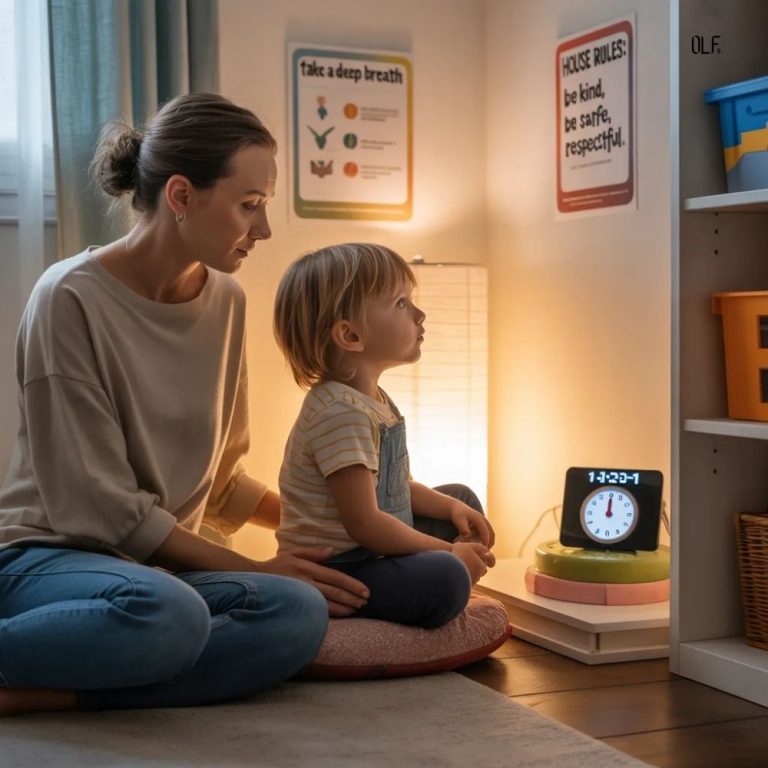
A visible timer makes time concrete. Children often struggle with abstract duration. When they can see time passing, they regulate effort more effectively. Set the timer for the agreed duration. When it starts, focus begins.
Explain clearly: “During this time, we stay on task. When the timer rings, you get a short break.” Keep instructions minimal once the timer is running.
Step Three: Define What Focus Means
Children benefit from clarity about expectations.
Focus means:
- Staying seated.
- Working on assigned task.
- Asking for help calmly if needed.
If distraction occurs, respond neutrally: “The timer is still running.” Avoid long lectures. The structure speaks for itself.
Step Four: Build in Predictable Breaks
When the timer rings, allow a five-minute movement break. Encourage physical reset:
- Stretching.
- Walking.
- Getting water.
- Brief outdoor air if possible.
Avoid screens during breaks. Screens tend to prolong disengagement. When the break ends, reset the timer if another block is needed.

What to Expect During the First Week
In the first few days, children may test the structure. They may complain about the timer or attempt to stretch breaks.
Respond consistently: “We work until the timer rings.” Avoid adjusting duration mid-session. Stability builds trust.
By the end of week one, many children begin to settle into the rhythm. Resistance often decreases because the workload feels contained.
Measuring Focus Growth
This system produces measurable results.
Track:
- Number of reminders per block.
- Time taken to begin work after start cue.
- Percentage of homework completed within scheduled blocks.
- Emotional intensity during homework time.
If reminders decrease from five per session to two within two weeks, progress is visible. If homework finishes within one or two blocks consistently, predictability has been established. The goal is not perfection. It is steady reduction in friction.
Responding to Common Challenges
“This Is Too Much.”
Break the assignment into sections before starting the timer. Define one clear task per block.
“For this block, complete the first ten math problems.” Clear targets reduce overwhelm.
Slow Work Pace
If a child works slowly to avoid completion, maintain the structure without extending it indefinitely. When the timer ends, the break occurs. The next block continues.
This prevents homework from consuming the entire evening while reinforcing effort expectations.
Frequent Help Requests
If a child repeatedly calls for assistance during focus time, encourage brief self-attempt before intervening: “Try for two minutes. Then I’ll check.” This builds independent problem-solving gradually.
Age Adaptations
Ages 5–7
Keep blocks short. Sit nearby during focus time to support regulation. Independence builds gradually.
Ages 8–10
Encourage independent block management. Allow the child to set the timer under supervision.
Ages 11–12
Shift responsibility further. Ask: “How many blocks do you think you’ll need?” This builds planning skills while maintaining structure.
Why Timed Blocks Build Real Focus
Focus is not a personality trait. It is a trained skill.
Timed blocks teach children that attention can be sustained for a defined period. The visible end point reduces anxiety and increases effort.
Children begin to internalize pacing. They learn how long tasks typically take. They become less likely to avoid starting because the work feels manageable.
Over time, the brain adapts to this pattern. Starting becomes easier. Staying engaged becomes more natural.
Long-Term Outcomes
A predictable homework routine builds more than academic completion. It strengthens executive function.
Children learn:
- Task initiation.
- Time awareness.
- Work-break balance.
- Emotional regulation during effort.
Conflict decreases because expectations are clear and consistent. Parents move from constant prompting to structured supervision. Children experience mastery rather than daily negotiation.
The outcome is not silent homework time every day. The outcome is consistent completion within a contained window and reduced emotional escalation.
A Steady System Reduces Daily Friction
Homework does not need to dominate evenings. When work is contained in predictable blocks, children understand the boundaries of effort. They begin to trust that focus has a beginning and an end. This trust changes behavior.
With repetition, the timer becomes less of a tool and more of a habit. Children transition into work mode more quickly. Breaks feel earned rather than negotiated. Evenings feel calmer.
A predictable homework routine does not eliminate challenges, but it provides structure that supports growth. Timed work blocks create measurable improvement in focus, and measurable improvement reduces conflict.
Consistency, not intensity, builds attention. And attention, practiced daily in manageable segments, becomes a lasting skill.