
Children begin forming beliefs about money long before they understand numbers formally. They observe how adults talk about spending. They notice what gets purchased immediately and what gets delayed.
They hear phrases like “we can’t afford that” or “maybe later.” Even if those comments feel casual, they shape a child’s understanding of value, scarcity, and choice.
Many parents want their children to develop financial responsibility, yet money conversations often feel abstract or inconsistent. An allowance might be given irregularly. Spending decisions might be impulsive or negotiated on the spot. Without structure, money becomes either invisible or emotionally charged.
What builds financial awareness is not complex budgeting apps or long lectures. It is a simple, visible system that connects money to decision-making.
The three-jar structure provides that clarity. It is concrete, developmentally appropriate, and measurable. When implemented consistently, it teaches children how to save, how to spend intentionally, and how to give thoughtfully.
The goal is not creating strict savers. The goal is building balanced financial habits early.
Why Children Need Structure Around Money
Money is abstract for young children. A five-dollar bill feels similar to a ten-dollar bill unless context is provided. Without visible boundaries, children struggle to understand trade-offs.
Additionally, executive function skills related to planning and delayed gratification are still developing throughout childhood. Expecting a child to save without guidance is unrealistic. They need a visible system that divides money into clear purposes.
When money is structured into categories, children begin recognizing that every dollar has a direction. That awareness builds internal control rather than impulsive spending.

The Three-Jar System
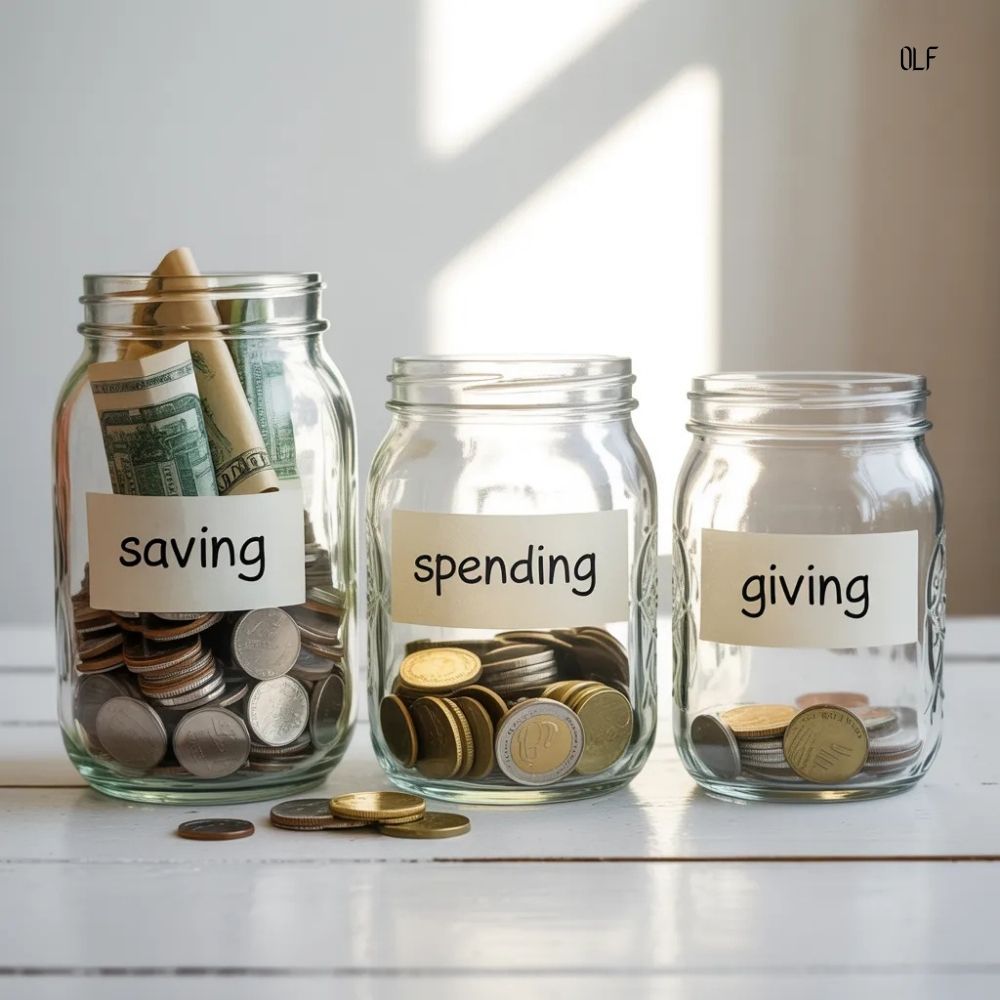
The system uses three labeled jars:
- Save
- Spend
- Give
Each jar represents a purpose. When a child receives money through allowance, gifts, or small jobs, it is divided among the jars using a predetermined ratio.
A common starting ratio is:
- 40% Save
- 50% Spend
- 10% Give
The exact percentages can vary by family values, but consistency matters more than precision. The physical act of dividing money makes the lesson tangible.
Step-by-Step Implementation
Step One: Introduce the Purpose of Each Jar
Explain simply and clearly. The Save jar is for larger future goals. The Spend jar is for small purchases the child wants now. The Give jar is for helping others or contributing to something meaningful.
Keep language practical: “Some money is for now. Some is for later. Some is for helping.” Avoid long explanations about financial theory. Children learn through repetition.
Step Two: Set a Consistent Money Source
The system works best when money enters the jars predictably. This may be through:
- Weekly allowance tied to household responsibility.
- Payment for optional extra tasks.
- Gift money from relatives.
Whatever the source, consistency builds rhythm. When the child receives money, sit down together and divide it immediately. Avoid postponing this step. The physical division reinforces structure.
Step Three: Allow Natural Decision-Making in the Spend Jar
The Spend jar gives children controlled freedom. If they want a small toy or treat, they use that jar. If they empty it quickly, they wait until the next allowance cycle.
Avoid supplementing the Spend jar with parental money. If parents consistently add funds, the lesson weakens. Natural consequences teach pacing.
Step Four: Guide Goal Setting in the Save Jar
The Save jar builds delayed gratification. Help the child choose a clear goal, such as a larger toy or game.
Write the goal and cost on a small card near the jar. Visual tracking increases motivation.
You might say: “You’re halfway to your goal.” This reinforces progress rather than pressure.
Step Five: Encourage Thoughtful Giving
The Give jar builds empathy and social awareness. Children can choose to donate to a cause, support a school fundraiser, or help someone in need.
Avoid dictating where the money must go. Ownership increases meaning. This step teaches that money has relational impact, not just personal value.
What to Expect in the First Month
Initially, children may spend the Spend jar quickly. That is part of learning. Resist rescuing.
After one or two cycles, many children begin pacing purchases more carefully. They realize that empty jars require waiting.
Within four to six weeks, measurable progress often includes:
- Increased willingness to save toward a larger goal.
- Fewer impulsive purchase requests.
- Questions about price comparisons.
- Independent division of money without prompting.
Track how often your child asks you to buy something versus checking their own jar first. A shift toward checking their jar indicates growing financial awareness.
Adjusting by Age
For children ages five to seven, keep the system very visual. Clear jars work best so progress can be seen.
For ages eight to ten, begin introducing simple written tracking alongside the jars. A small notebook listing deposits and withdrawals builds accountability.
For ages eleven to twelve, the system can transition gradually toward a basic bank account while maintaining the three-category structure digitally.
The framework stays the same even as the tools evolve.
Measuring Practical Financial Awareness
Financial awareness becomes visible through behavior changes.
You may notice:
- The child comparing prices before spending.
- The child deciding not to purchase something impulsively.
- The child choosing to wait and combine funds.
- The child asking how much something costs before requesting it.
These behaviors signal internalization of value and trade-offs. If impulsive purchase requests decrease within two months, the system is working.
The Long-Term Skill Being Built
The three-jar system builds more than budgeting. It teaches decision-making. Children learn that money involves choice. Every purchase has an opportunity cost. Every saving decision requires patience.
They also learn generosity as a consistent practice rather than a rare event.
Over time, this balanced framework prevents extremes. Children do not grow into adults who spend without thought or hoard without purpose. They grow into individuals who understand allocation.
Practical financial awareness develops gradually through repetition. Each allowance cycle becomes a small lesson in trade-offs and planning.
A Simple System With Lasting Impact
Financial literacy does not begin in high school. It begins with simple habits in elementary years. When money is divided visibly into saving, spending, and giving, children see that financial decisions have structure.
The three-jar system requires minimal setup but produces measurable growth. It reduces impulsive demands, strengthens patience, and builds generosity.
Most importantly, it shifts money conversations from emotional negotiation to structured learning.
With steady implementation, children move from asking, “Can you buy this for me?” to asking, “Do I have enough in my Spend jar?”
That shift reflects real independence. And independence with money, practiced early and consistently, becomes a lifelong advantage.