
Large school projects often trigger disproportionate stress in otherwise capable children. The assignment is written clearly. The deadline is weeks away. Yet the project sits untouched until pressure builds. What looks like procrastination is usually overwhelm.
When a task feels big and undefined, children struggle to begin. Their brains are still developing executive function skills such as planning, sequencing, and time estimation. If the only instruction is “Start your project,” that instruction lacks shape.
Overwhelm decreases when tasks become visible, scheduled, and broken into defined actions. The four-step structure below provides clarity without micromanaging. It replaces last-minute panic with steady progress.
The outcome is measurable: earlier starts, fewer emotional shutdowns, and smoother completion.
Step One: Define What “Done” Actually Looks Like
Before dividing the project into parts, clarify the final expectation. Many children feel stuck because they do not understand what the finished project should include. Sit down together and review the assignment sheet carefully. Ask simple, grounding questions:
- “What exactly needs to be turned in?”
- “How many pages?”
- “Is there a presentation?”
- “Is there a grading rubric?”
Write down the final components clearly. For example:
- Written report, three pages
- Poster board with visuals
- Five-minute presentation
When children see the destination clearly, uncertainty decreases. Avoid overcomplicating this stage. The goal is clarity, not perfection.
The measurable shift in this step is reduced avoidance. Once expectations are concrete, beginning feels less intimidating.
Step Two: Break the Project Into Specific, Visible Pieces
After defining the outcome, divide the project into manageable steps. Instead of saying, “Work on the research,” make it concrete:
- Find three sources
- Write five bullet notes from each source
- Draft introduction paragraph
- Create outline for body paragraphs
- Design poster layout
Each step should be small enough to complete in 20 to 30 minutes. If a step still feels overwhelming, divide it again. For example, “Write report” becomes:
- Write introduction
- Write first body paragraph
- Write second body paragraph
- Write conclusion
Children gain confidence when they see progress in small increments. The measurable outcome of this step is reduced resistance to starting work because the task now has edges.
Step Three: Schedule the Pieces Across Realistic Days
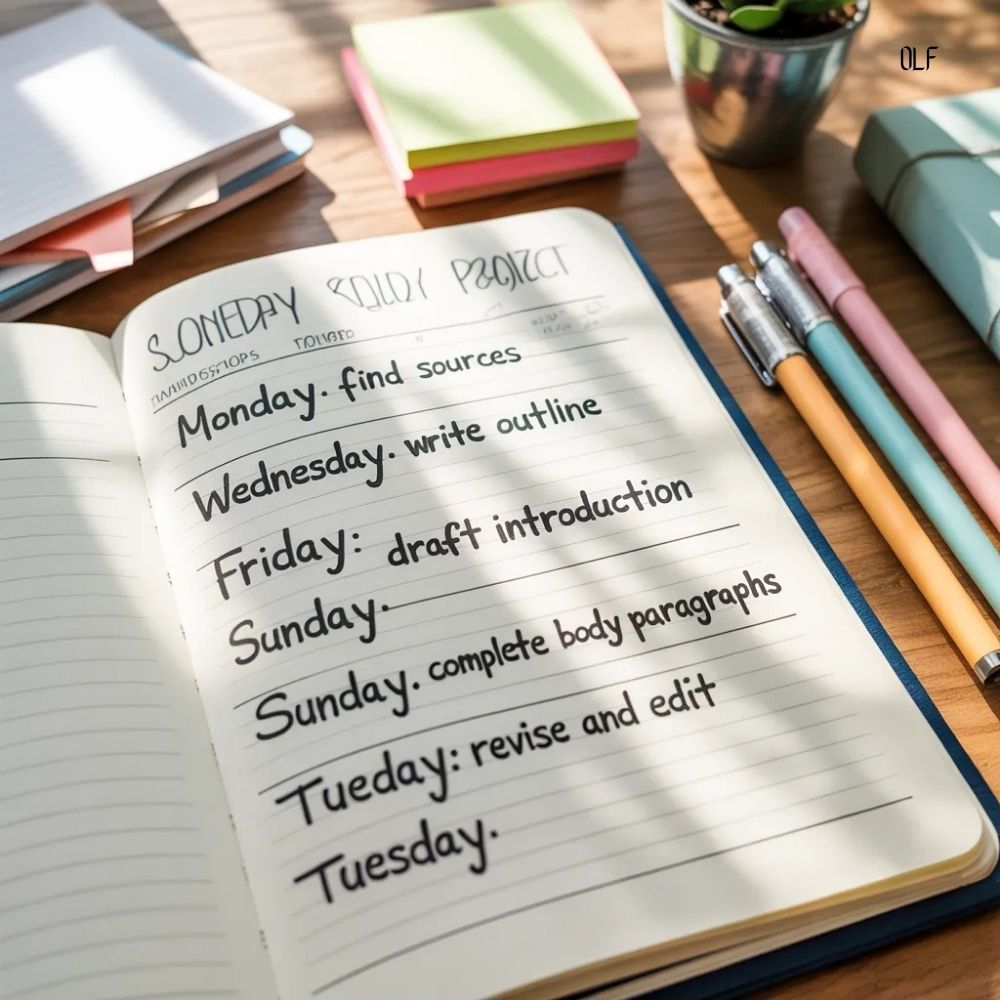
A divided list is helpful, but it becomes powerful when paired with scheduling. Look at the calendar together and assign specific tasks to specific days. Spread them out evenly and include a buffer day before the due date. For example:
- Monday: Find sources
- Wednesday: Write outline
- Friday: Draft introduction
- Sunday: Complete body paragraphs
- Tuesday: Revise and edit
Keep each session short and predictable. Avoid stacking too many steps on one evening, especially after high-demand days.
The scheduling stage shifts the project from abstract to structured. It also reduces the mental burden of remembering what to do next. The measurable change here is earlier project initiation and less last-minute rushing.
Step Four: Focus Only on Today’s Task
When it is time to work, narrow attention to the single scheduled step. Do not revisit the entire project in conversation. Keep the scope small: “Today you are writing the introduction.”
If frustration appears, remind your child: “We’re only doing this one piece.” Once the step is completed, mark it visibly on the checklist. Crossing off tasks reinforces momentum.
If attention fades, use short work blocks of 20 to 25 minutes with a brief break afterward. Gradual attention building supports long-term independence.
The measurable outcome is improved sustained focus and fewer emotional reactions during work sessions.
A Realistic Example
Imagine a sixth-grade student assigned a history presentation due in two weeks. Without structure, the project remains untouched for ten days. Stress spikes. The final weekend becomes chaotic.
Using the four-step method, the parent and child sit down the day the assignment is given.
- Step One: They clarify that the project requires a three-page paper and a five-minute oral presentation.
- Step Two: They divide it into ten small tasks.
- Step Three: They schedule two or three tasks per week across available evenings.
- Step Four: Each work session focuses only on the task listed for that day.
By the final weekend, only minor revisions remain. The difference is visible: no panic, no late-night arguments, and a steadier tone throughout the week.
Handling Common Obstacles
If your child becomes stuck mid-task, avoid taking over. Instead ask: “What’s the smallest next step?”
If perfectionism appears, remind them that drafts can be revised later. If fatigue sets in, shorten the session but complete the step. Consistency matters more than length.
The Long-Term Skill Being Built
This method builds planning, time awareness, and task sequencing. Children learn that large projects are simply collections of smaller actions.
They experience success in manageable increments rather than reacting to looming deadlines. Over time, they begin dividing projects independently before being prompted. That shift represents true executive function growth.
Structure Replaces Overwhelm
Big projects feel intimidating when they appear as a single, undefined demand. When broken down, scheduled, and completed step by step, they become manageable.
Delivered consistently, this structure reduces overwhelm and transforms large assignments into steady progress.
And steady progress builds capable, confident learners who know how to approach complex tasks without shutting down.