Big transitions often bring out behaviors parents thought were already behind them. A child who had been sleeping independently begins waking at night.
A previously cooperative sibling becomes irritable. A toilet-trained preschooler has accidents again. These shifts can feel discouraging, especially when families have worked hard to build stability.
Transitions disrupt rhythm. Whether the change involves starting school, welcoming a new baby, moving homes, changing caregivers, or adjusting to a new schedule, children experience a temporary loss of predictability. When predictability decreases, behavior often regresses.
Regression is not failure. It is a stress signal. Children rely heavily on routine to feel secure. When something significant changes, their nervous system scans for stability. If they cannot find it easily, they return to earlier behaviors that previously brought comfort or attention.
The goal during transitions is not eliminating emotional reaction. It is reducing uncertainty in advance.
The Preview–Practice–Predict framework provides a structured way to prepare children before change occurs and support them after it begins. When implemented consistently, it leads to measurable reduction in behavioral regression and faster adjustment.
Why Transitions Trigger Regression
Children process change differently than adults. Adults often focus on logistics and long-term outcomes. Children focus on immediate disruption.
Their questions are rarely about the bigger picture. Instead, they wonder:
- Will my routine stay the same?
- Will I still have time with my parent?
- Will I know what to do?
Even positive transitions, such as a new sibling or a move to a larger home, alter patterns children depend on. Without preparation, the uncertainty feels large.
Because emotional regulation is still developing, children express stress behaviorally rather than verbally. That expression may look like clinginess, defiance, sleep disruption, or increased sensitivity. Preparation reduces the emotional load.
The Preview–Practice–Predict Framework
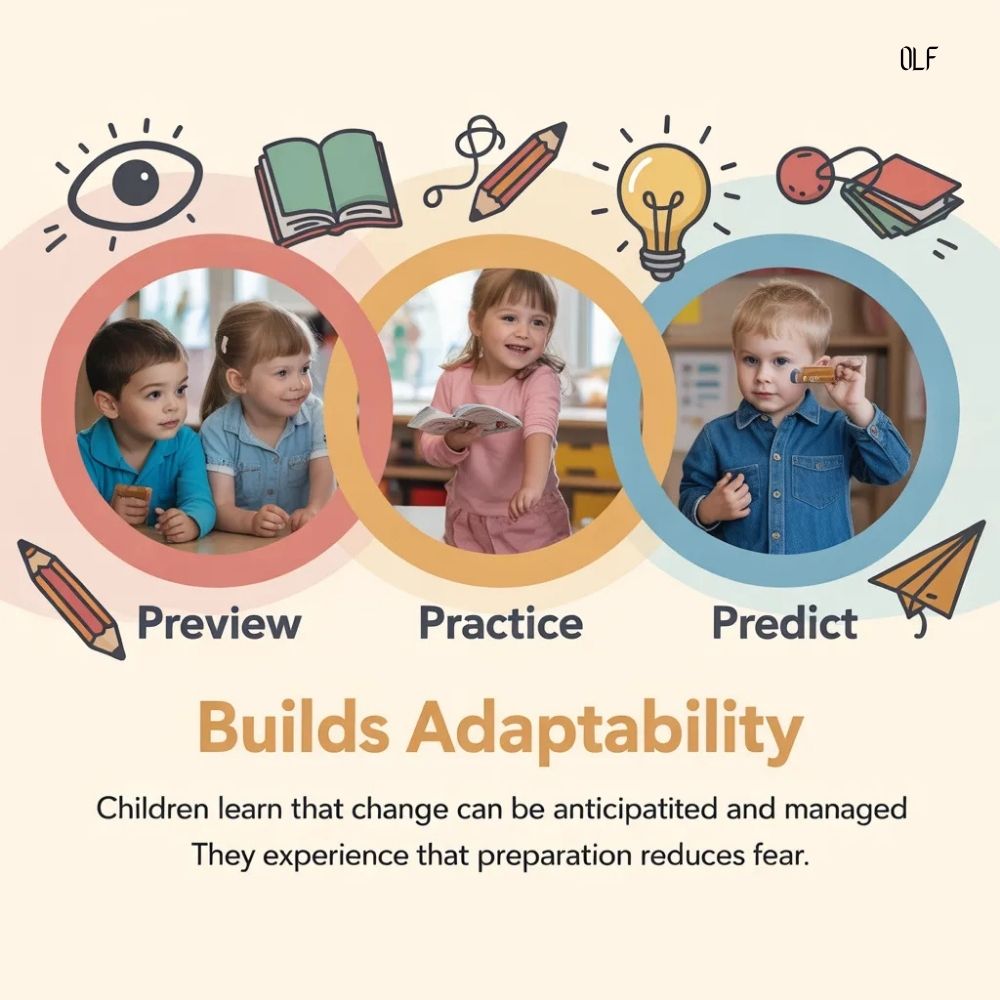
This system contains three stages that work together:
- Preview what will change.
- Practice the new experience in small steps.
- Predict what will stay the same.
Each stage reduces uncertainty from a different angle.
Step One: Preview
Previewing involves calmly explaining what is about to happen before it happens. The key is clarity without overload.
If a child is starting a new school, the preview might sound like this: “Next Monday, you will go to your new classroom. Your teacher’s name is Mrs. Adams. School starts at 8:30, and I will pick you up at 3:00.”
Keep language simple and factual. Avoid dramatic tone or excessive reassurance. Overexplaining can signal that something is wrong.
For younger children, visual aids help. Drawing a simple picture of the new classroom or creating a basic timeline of the day reduces abstraction.
Previewing works best when repeated calmly over several days rather than delivered once.
The measurable goal of this stage is familiarity. If the child can describe what will happen in basic terms, previewing has worked.
Step Two: Practice
Practice turns abstract change into lived experience in controlled doses.
If the transition involves a new school, visit the building beforehand if possible. Walk past the entrance. Stand near the playground. If that is not possible, role-play at home.
You might say: “Let’s practice how you’ll hang up your backpack.”
If a new baby is arriving, practice gentle holding with a doll. Rehearse diaper changes through pretend play. If bedtime will shift because of schedule changes, practice the new bedtime routine a week early.
Practice reduces shock. It gives the child muscle memory for the upcoming change.
The measurable outcome here is reduced anxiety during rehearsal. If the child engages in role-play calmly, readiness is increasing.
Step Three: Predict
Prediction is the stabilizing anchor of the framework. While previewing focuses on what will change, predicting emphasizes what will remain consistent.
Children need to hear explicitly: “Even when the baby comes, we will still read together every night.” Or: “Even at the new school, I will always pick you up.”
This step counters the child’s internal fear of total disruption. Predicting sameness builds security. It reassures the nervous system that not everything is shifting. The measurable outcome is reduced repetitive questioning about separation or routine.

What to Expect During the Transition
Even with preparation, some regression may still occur. The difference is intensity and duration.
Without preparation, regression can last weeks and feel chaotic. With the Preview–Practice–Predict framework, most behavioral shifts are shorter and less extreme.
You may still see:
- Increased clinginess.
- Temporary sleep disruption.
- Heightened emotional sensitivity.
The key is maintaining calm consistency rather than tightening control.
If regression appears, return to prediction: “You are still safe. Our bedtime routine is the same.” Repetition reinforces security.
Supporting Recovery After the Transition Begins
Once the transition is underway, keep routines as stable as possible in other areas. Maintain meal times, bedtime rituals, and connection moments.
Add brief daily check-ins: “What felt different today?”
Keep these conversations short and neutral. The goal is expression, not analysis. Avoid interpreting every behavior as transition-related. Continue regular boundaries calmly.
Age Adjustments
For preschoolers, keep previews visual and concrete. Use drawings or simple stories. Practice through play.
For elementary-aged children, allow them to ask questions and contribute ideas. They may want to pack a comfort item or choose part of the new routine.
For older children approaching adolescence, involve them in planning. Ask what concerns them and what would help them feel prepared.
The structure remains the same across ages. The language and depth expand.
Common Mistakes to Avoid
Avoid minimizing feelings with statements like, “It’s not a big deal.” Even if the change feels small to an adult, it can feel significant to a child.
Avoid overwhelming them with too many details at once. Information should be delivered gradually.
Avoid promising certainty where none exists. Instead of saying, “Everything will be perfect,” say, “We will figure it out together.” Stability comes from presence, not perfection.
The Long-Term Skill Being Built
The Preview–Practice–Predict framework builds adaptability. Children learn that change can be anticipated and managed. They experience that preparation reduces fear.
Over time, they begin applying these steps internally. Before a new activity, they may ask what it will be like. They may rehearse mentally. They may identify what will stay consistent.
These are resilience skills. Adaptability does not mean absence of emotion. It means emotional recovery that is shorter and less disruptive.
A Steady Approach to Change
Transitions are unavoidable. Schools change. Schedules shift. Families grow. Moves happen. What determines a child’s experience is not whether change occurs, but how it is handled.
When parents preview clearly, practice intentionally, and predict stability consistently, children approach change with greater confidence.
Behavioral regression may still appear briefly, but it resolves faster. Emotional episodes are less intense. Adjustment becomes smoother.
Preparation does not eliminate uncertainty entirely, but it reduces it enough for children to feel secure.
And security, reinforced through structure, allows them to navigate change without losing their footing.